
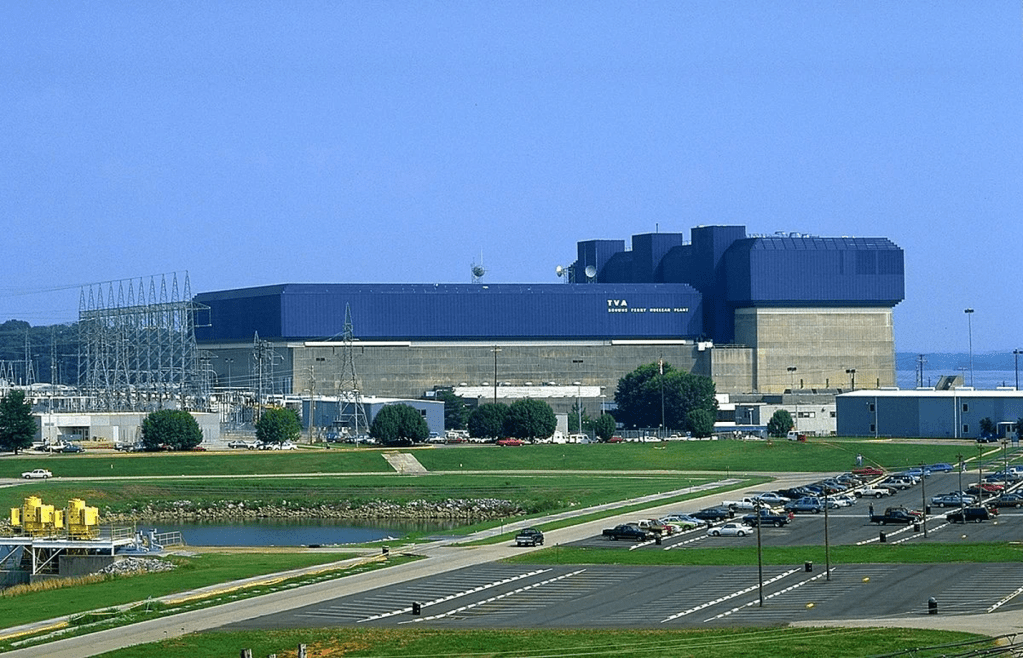
Kairos Power, a maker of small modular reactors (SMRs), has broken ground on its second nuclear reactor, Hermes 2, in Oak Ridge, Tennessee.
In October of 2024, Google began a collaboration with Kairos Power to unlock up to 500 MW of nuclear power for the U.S. electricity system through multiple deployments of their Molten Salt and Flouride salt cooled reactors.
Kairos Power, a California company was designing a fluoride salt-cooled high temperature reactor (FHR) using Triso-coated particle fuel in a pebble bed configuration but appear to have moved to SMRs.
FHRs offer several potential benefits, including enhanced safety, high thermal efficiency, and adaptability to various applications. FHRs appear to be abandoned in favor of SMRs. FHRs are a type of molten salt reactor (MSR). While traditional MSRs dissolve fuel directly into the molten salt coolant, FHRs specifically use solid fuel (typically TRISO pebbles) cooled by liquid fluoride salt. FHRs are considered Generation IV reactors.
Hermes 2 was originally approved by the Nuclear Regulatory Commission (NRC) as a nonpower test reactor facility in late 2024, with a licensed lifetime of 11 years. The permits authorized Kairos to build a facility with two molten salt–cooled 35-MWt test reactors (MSRs) and demonstrate power production of 20 MWe.
Plans changed with a power purchase agreement between the Tennessee Valley Authority and Google, leading Kairos to announce a change to a 50-MWe output for the Hermes 2 site.
Hermes is taking an new approach, switching to small modular reactors (SMRs), which are easier to build and have a lower risk profile.
Alameda, California-headquartered Kairos Power is among many nuclear energy companies that are building SMRs. The technology is preferred, since the nuclear plant components are modular, can be built at scale and the plant is designed to shut down in case of an accident.
What IT Do
Small Modular Reactors (SMRs) are advanced nuclear reactors with a power capacity typically up to 300 MW(e) per unit, roughly one-third of traditional reactors. They are designed to be factory-built, modular, and transported to sites for installation, offering lower initial capital costs, enhanced safety features, and greater flexibility for smaller grids, remote locations, or industrial applications.
Top U.S. SMR Developers and Technologies:
NuScale Power is currently the top U.S. producer of SMRs, leading in regulatory milestones as the first to secure U.S. Nuclear Regulatory Commission (NRC) approval for its VOYGR design.
It is headquartered in Tigard, Oregon. The company’s VOYGR power plant, which uses 50 MWe modules and scales to 12 modules, was the first SMR to be certified by the US Nuclear Regulatory Commission.
- NuScale Power: Leads with the first NRC-certified SMR design. Their VOYGR plant uses the NuScale Power Module, a 77 MWe reactor designed for a 12-module configuration.
- TerraPower: Founded by Bill Gates, it is the first U.S. company to move to construction, breaking ground on its Natrium sodium-cooled fast reactor in Wyoming in 2024.
- GE Hitachi Nuclear Energy: Develops the BWRX-300, a 300 MWe boiling water reactor. It has strong partnerships in the U.S., Canada, and Europe.
- X-energy: Focuses on the Xe-100 high-temperature gas-cooled reactor, focusing on industrial applications.
- Holtec International: Developing the SMR-160, a 160 MWe pressurized water reactor, focusing on replacing coal-fired boilers.
- Oklo: Advancing the Aurora microreactor, utilizing fast reactor technology.
What is Hermes?
Kairos built Hermes-1, a low-power demonstration reactor, a scaled-down version of its fluoride salt-cooled high-temperature reactor technology. This is the first non-light-water reactor approved by the US Nuclear Regulatory Commission (US NRC).
Hermes-1 is not built to produce electricity, which is a crucial step in demonstrating the incorporation of components such as the tri-structural isotropic (TRISO) coated fuel particle and flibe molten fluoride salt coolant.
Lessons learned from the assembly of Hermes-1 will be used to build Hermes-2, which, when ready, will supply 50 MW of carbon-free energy to the Tennessee Valley Authority grid and help power Google’s data centers in Tennessee and Alabama.
How IT Do IT
How will the SMR be built?
Kairos Power will fabricate the components required for the Hermes-2 project at its Manufacturing Development Campus in Albuquerque, New Mexico. Barnard Construction Company, which has been contracted to build both the Hermes projects, will assemble the components once they reach Oak Ridge.
The construction process will use modular methods, including precast concrete and a seismically isolated foundation. These are aimed at improving the structure’s safety and reducing the construction costs and timelines. The standardized and repeatable design can then be used to build other small nuclear plants at multiple locations.
Hermes-2 is being built on the site that previously housed the Oak Ridge Gaseous Diffusion Plant, continuing its legacy of working with nuclear material. The plant is a precursor to a full-scale commercial plant and will help Kairos Power advance its technology, supply chain, and construction capabilities.
“For Hermes 2, we know exactly what we need to do to manage that legacy infrastructure and how to remove it in a cost-effective and schedule-efficient way,” Laufer said, “and that would not have been possible if we had just gone out and done it cold. This is a real, tangible time and money savings from the iterative process.” Mike Laufer, co-founder and CEO at Kairos Power CEO in a press release.
As the immediate precursor to Kairos’s full-scale commercial plants, Hermes 2 is expected to advance technology, licensing, supply chain, and construction certainty for future deployments.
“It’s not lost on us that the urgency of this moment has only increased,” Laufer said. “The country needs everything that nuclear power can deliver, and the burden is on us to prove that we can deliver it. We take that responsibility seriously.”




 What IT Do. How IT Do IT.
Leave a comment