
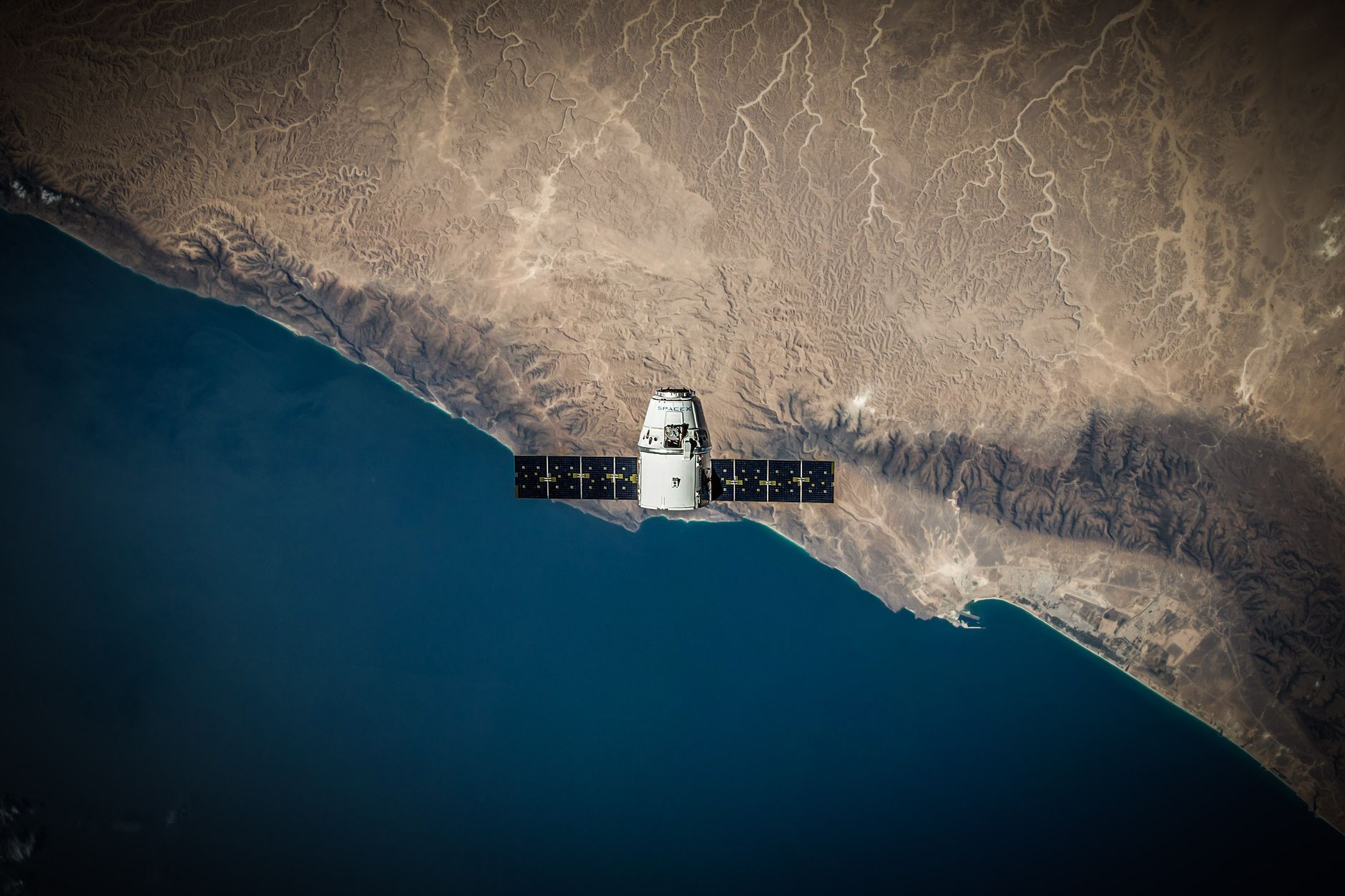
Thursday, the prototype satellite for Project Suncatcher, built in partnership with Planet Labs, launched into orbit aboard the Transporter-18 rideshare mission with SpaceX. The Google team has confirmed contact with the satellite and it is operating as expected.
This is the first step in a long-term research moonshot exploring whether space could one day host scalable machine learning infrastructure.
For Project Suncatcher, Google faced two massive environmental hurdles when sending its Trillium Tensor Processing units or TPUs into orbit: radiating heat without air, and shielding silicon from cosmic rays.
Thermal Cooling: Purely Radiative Heat Management
On Earth, AI data centers depend heavily on fans, liquid cooling loops, and massive HVAC chillers. Because the vacuum of space has no air for convective cooling, Google had to design a completely customized, conductive-to-radiative architecture.
- The Layered Hardware Stack: The TPUs are mounted onto a motherboard. Directly above the chips is a compliant, pale-green thermal interface material (thermal putty) sheet used to maximize surface contact. This connects directly to custom aluminum and copper heat-spreading layers.
- Passive Heat Pipes: These metallic paths quickly draw the intense heat away from the core processing motherboard and route it toward the outer edges of the refrigerator-sized spacecraft.
- The Radiator Panel: The heat pipes dump the thermal load into a specialized external radiator panel, which slowly bleeds the energy out into deep space as infrared light.
- The 15-Minute Operational Limit: Because radiative cooling is fundamentally slower than Earth-based airflow, the satellite cannot run continuously. The TPUs operate in 15-minute operational bursts to process AI queries, after which they must shut down completely to let the radiator panel catch up and dump the accumulated heat.
Radiation Testing: Simulating Space on Earth
Cosmic radiation and solar particles can easily corrupt calculations (causing “bit flips”) or permanently destroy standard commercial silicon. Google put its off-the-shelf Trillium architecture through grueling ground simulations before launch.
- The Cyclotron Proton Beam: Google took its chips to the Crocker Nuclear Laboratory at the University of California, Davis. There, the TPUs were bombarded with an intense, simulated stream of solar radiation and high-energy cosmic rays.
- Exceeding a 5-Year Dosage: Google reported that the core TPU architecture held up remarkably well, surviving an ionizing radiation dose greater than what the satellite would naturally encounter over a 5-year space mission.
- The Memory Bottleneck: While the core processing logic of the TPU handled the radiation with high resilience, testing revealed that the attached High-Bandwidth Memory (HBM) was significantly more sensitive to radiation-induced errors. The current 1-year orbit mission is explicitly designed to test how effectively the satellite’s software can catch and correct these memory errors on the fly.
Over the coming weeks, Google will gather in-orbit data on how Google Tensor Processing Units or TPUs handle the physical stress of spaceflight and the radiation and thermal extremes of space.These are specialized, application-specific integrated circuits (ASICs) designed by Google specifically to accelerate machine learning and AI workloads. The prototype Suncatcher satellite (nicknamed “MVP”) carries four Trillium TPUs tasked with running its Gemma AI model.
Google announced in November 2025. It asks whether AI might one day run on sunlight in orbit rather than on a strained power grid on the ground. The ambition is vast and the first step is modest, a single kilowatt of solar power and chips that can run for only a quarter of an hour before their radiators need to catch up.
SpaceX, a company in which Google has held a stake since 2015, rents ground computing from SpaceX at $920 million a month, and SpaceX plans a million computing satellites of its own.
The SpaceX launch will settle a narrow set of engineering questions, like whether sunlight in orbit can ever beat a power line on cost.
QUICK FACTS ABOUT THIS PROJECT
- Google’s MVP satellite launched on October 1, 2026 with four TPUs and about one kilowatt of solar power.
- Google pays SpaceX $920 million a month for ground Graphics Processing Units GPUs until June 2029. GPUs are highly flexible, parallel-processing chips originally designed for rendering graphics but now are used for training and running AI models.
- Hyderabad’s TakeMe2Space flies its own orbital computing satellite, MOI-1a, on the same Transporter-18 mission.
Google’s peer-reviewed paper is now available in Joule, detailing the research behind this mission. Some things can only be tested in space. As experiments begin, Google will use what is learned to refine AI designs.




Leave a comment